Five AI models, one editorial task: the Grok 4.7 follow-up
On this page
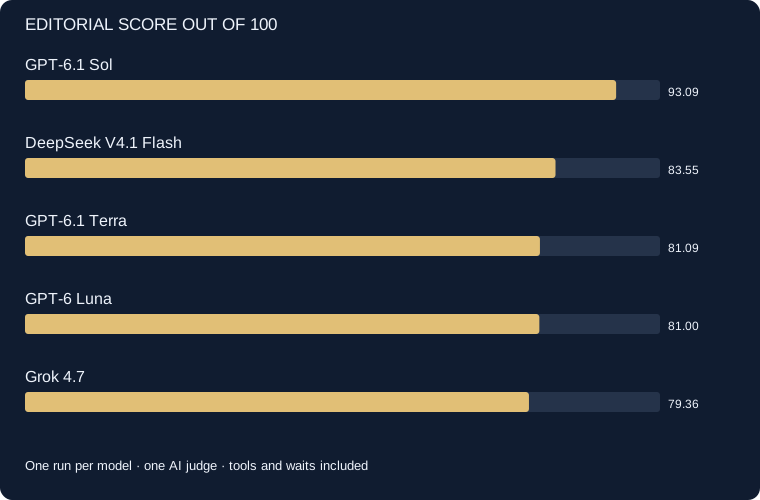
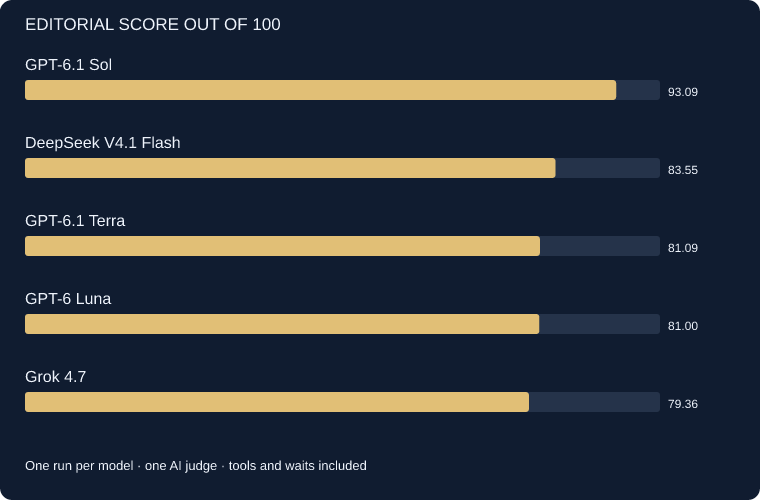
GPT-6.1 Sol led this five-submission editorial review with 93.09 out of 100. Grok 4.7's submission scored 79.36. These are assessments of five particular article clusters, not a general ranking of AI models.
We gave Grok the same eleven-article commission used in our earlier editorial benchmark and compared its frozen original with the Sol, Luna, DeepSeek and Terra originals. Each submission included one pillar, ten supporting articles and editorial planning material. A fresh GPT-6.1 Sol reviewer assessed all 55 drafts against the same weighted rubric. Digital Sanctum has a commercial interest in AI-assisted work; this is an exploratory workflow comparison, not an independent academic study.
What the editorial review found

One complete submission per model; one Sol AI judge. Scores are not evidence of statistical significance or general superiority.
Download SVG · Download PNG · Full precision source data · Download CSV
View figure data
| Model | Recorded values |
|---|---|
| GPT-6.1 Sol | 93.09 |
| DeepSeek V4.1 Flash | 83.55 |
| GPT-6.1 Terra | 81.09 |
| GPT-6 Luna | 81.00 |
| Grok 4.7 | 79.36 |
DeepSeek scored 83.55, Terra 81.09 and Luna 81.00 in this new review. The original two-, three- and four-model scores remain separate assessments. In a later head-to-head pass, the reviewer preferred Sol against every other cluster in both presentation orders. Terra and Luna were tied in one order; the reverse narrowly favoured Terra. Those two directions share a judge and context, so they are not independent replications.
DeepSeek's weighted total was higher than Terra and Luna, while the reviewer preferred their clusters in head-to-head comparisons because it regarded two passages in DeepSeek's original as material guidance issues. Grok's original had three articles flagged for holdout and statistical guidance. These are advisory AI findings; technical and editorial human review has not been completed. DeepSeek's later revised public copies already address the specific original-draft issues inspected here. A high score does not remove a publication blocker, and an unflagged article is not proof that it contains no errors.
How long the workflows took

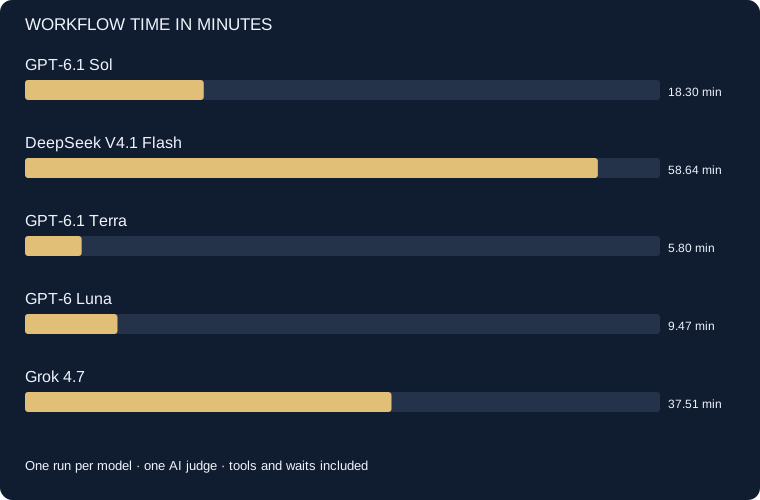
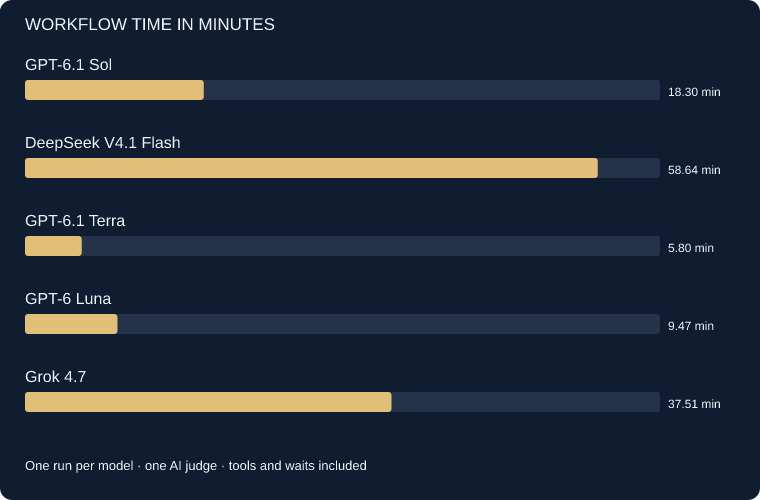
The chart shows minutes; the table shows seconds. Includes tools and waits. DeepSeek includes unmeasured approval waits; Grok includes retries and context compaction.
Download SVG · Download PNG · Full precision source data · Download CSV
View figure data
| Model | Seconds |
|---|---|
| GPT-6.1 Sol | 1097.91 |
| DeepSeek V4.1 Flash | 3518.36 |
| GPT-6.1 Terra | 348.14 |
| GPT-6 Luna | 567.97 |
| Grok 4.7 | 2250.86 |
The clocks include research, tools and waits rather than pure inference latency. DeepSeek's CommandCode workflow included user approval waits; Grok's CLI workflow included transient retries and context compaction. The models ran on different dates, providers and harnesses. A shorter clock here does not establish that a model is inherently faster.
What we recorded for token usage

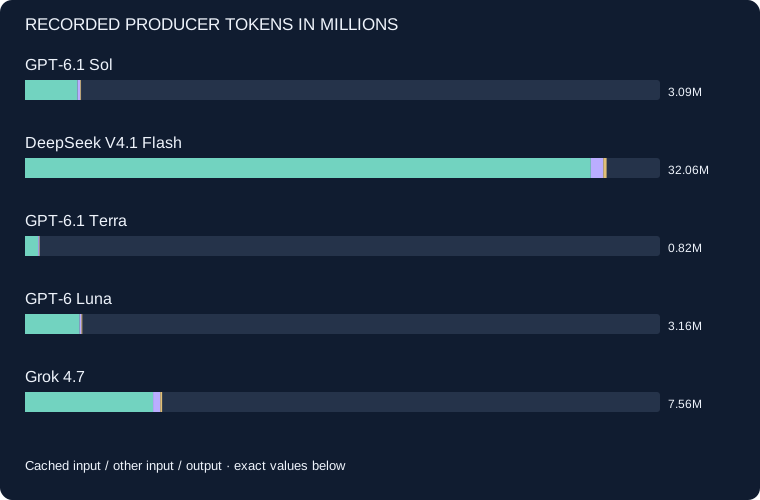
Bars show cached input (teal), other input (purple) and output (gold). Cached input is included in input. Native tokenizers and reporting differ; no measured task invoice is available.
Download SVG · Download PNG · Full precision source data · Download CSV
View figure data
| Model | Recorded values |
|---|---|
| GPT-6.1 Sol | 3,046,820 input, 2,894,720 cached input, 41,141 output, 3,087,961 total |
| DeepSeek V4.1 Flash | 31,878,376 input, 31,187,584 cached input, 177,989 output, 32,056,365 total |
| GPT-6.1 Terra | 791,539 input, 728,192 cached input, 24,021 output, 815,560 total |
| GPT-6 Luna | 3,110,420 input, 3,009,152 cached input, 47,354 output, 3,157,774 total |
| Grok 4.7 | 7,457,445 input, 7,059,456 cached input, 101,062 output, 7,558,507 total |
The counters are recorded production usage, not estimated cache-hit rates. Input includes cached input; reasoning, where reported, is inside output. DeepSeek's separate reasoning count and any unpersisted background usage were unavailable. Tokenizers differ, and we did not measure a per-task invoice or infer one from a subscription. The five-way judge used 36,505,505 tokens separately, including 35,629,056 cached input tokens; that overhead is not included in producer figures.
Method and limitations
The production brief and rubric were retained from the original task. The reviewer used integer anchors in this new round and documented 236 substantive or hypothetical checks across the drafts. The 20 ordered head-to-head comparisons were made by the same judge in a continuing context, with earlier judgments visible. Blinding was attempted, but style and research dates could reveal clues; the judge shares the winning producer's model designation. One submission per model cannot establish general superiority or a statistical significance result.
The coordinator inadvertently displayed part of the private mapping after the judge had finished but before the external comparison freeze. The reviewer was not exposed, and verification found the frozen candidate and score bytes unchanged. This departure from the intended sequence is part of the record.
The configured DeepSeek alias was latest rather than a verified pinned 1017 or 1071 snapshot. Grok reported grok-4.7-build; an immutable weights snapshot was not established. Different providers, CLI versions, tools, supervision and dates are confounders. The review was claim-directed rather than exhaustive, and no study was reproduced.
See our editorial benchmark methodology and the earlier four-model results for the previous review and its evidence. The curated five-way data records full-precision scores and production counters.
The article assessments, weighted cluster scores, claim-check ledger, directed comparisons and file manifest make the review inspectable. The manifest distinguishes exact retained review files from the curated usage export.